Objectives
Standards and Skills

Science
Science as Inquiry
Physical Science
Science and Technology
Mathematics
Measurement
Problem Solving
Science Process Skills
Making Models
Investigating
Predicting
 Background Information
A look at the research aircraft flown by NASA and its predecessor, the National Advisory Committee for Aeronautics (NACA), since the 1940’s reveals an evolution of wing designs. In fact, each of the first series of NACA experimental research aircraft (“X-planes”) used different wing and tail configurations to tackle the problems of supersonic flight. These early jet aircraft had straight wings (X-1), wings that angled (swept) toward the tail (X-2), triangular (delta) wings (XF-92), and wings that could be moved in flight to change the angle of backward sweep (X-5). Each design added to our knowledge of high-speed flight.
 More recently, aircraft designs have incorporated wings that sweep forward (X-29), and even wings that sweep forward and backward at the same time (AD-1 oblique wing aircraft). The X-29 and X-31 also made use of small wing-like control surfaces called canards which are located ahead of the main wings. The X-36, which was flown during the late 1990’s, used canards and swept-back wings but had no vertical tail. (For additional background information see the Aircraft as Research Tools page at the end of this Educational Brief.)
- The students will:
- Build a glider.
- Learn how to change the flight characteristics of a glider.
- Conduct an experiment to answer a question.
Standards and Skills

Science
Science as Inquiry
Physical Science
Science and Technology
Mathematics
Measurement
Problem Solving
Science Process Skills
Making Models
Investigating
Predicting
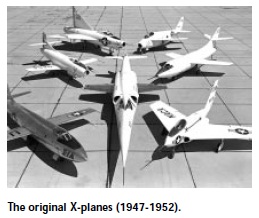
A look at the research aircraft flown by NASA and its predecessor, the National Advisory Committee for Aeronautics (NACA), since the 1940’s reveals an evolution of wing designs. In fact, each of the first series of NACA experimental research aircraft (“X-planes”) used different wing and tail configurations to tackle the problems of supersonic flight. These early jet aircraft had straight wings (X-1), wings that angled (swept) toward the tail (X-2), triangular (delta) wings (XF-92), and wings that could be moved in flight to change the angle of backward sweep (X-5). Each design added to our knowledge of high-speed flight.

