Ring seals
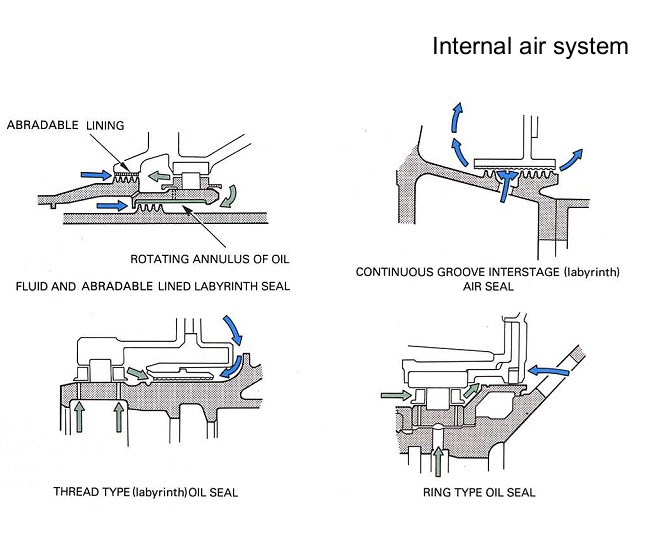
17. A ring seal (fig. 9-7) comprises a metal ring which is housed in a close fitting groove in the static housing. The normal running clearance between the ring and rotating shaft is smaller than that which can be obtained with the labyrinth seal. This is because the ring is allowed to move in its housing whenever the shaft comes into contact with it.
18. Ring seals are used for bearing chamber sealing, except in the hot areas where oil degradation due to heat would lead to ring seizure within its housing.
Hydraulic seals
19. This method of sealing is often used between two rotating members to sea a bearing chamber.
Unlike the labyrinth or ring seal, it does not allow a controlled flow of air to traverse across the seal,
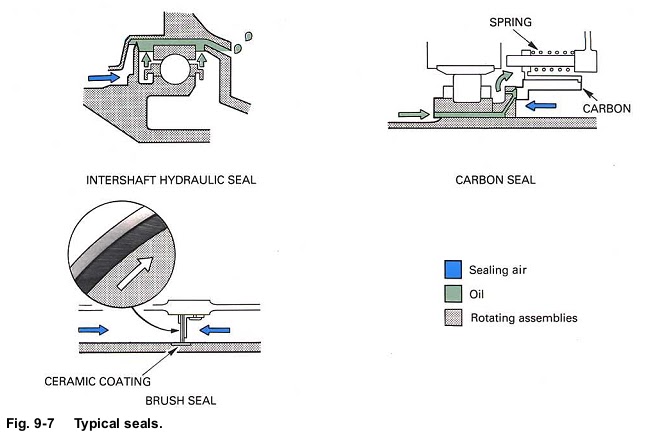
20. Hydraulic seals (fig. 9-7) are formed by a seal fin immersed in an annulus of oil which has been created by centrifugal forces. Any difference in air pressure inside and outside of the bearing chamber is compensated by a difference in oil level either side of the fin.
Carbon seals
21. Carbon seals (fig. 9-7) consist of a static ring of carbon which constantly rubs against a collar on a rotating shaft. Several springs are used to maintain contact between the carbon and the collar. This type of seal relies upon a high degree of contact and does not allow oil or air leakage across it. The heat caused by friction is dissipated by the oil system.
Brush seals
