Showing posts with label Fuel system. Show all posts

Wednesday, February 22, 2012

FUEL HEATING


96. The spill spray nozzle system, however, involves a somewhat modified type of fuel supply and control system from that used with the previous types. A means has to be provided for removing the


spill and also for controlling the amount of spill flow at various engine operating conditions. A
disadvatage of this system is that excess heat may be generated when a large volume of fuel is being recirculated to inlet. Such heat may eventually leadto a deterioration of the fuel.

FUEL HEATING


FUEL HEATING

100. On many engines, a fuel-cooled oil cooler (Part 8) is located between the L.P. fuel pump and the inlet to the fuel filter (fig. 10-13), and advantage is taken of this to transfer the heat from the oil to the fuel and thus prevent blockage of the filter element by ice particles. When heat transference by this means is insufficient, the fuel is passed through a second heat exchanger where it absorbs heat from a thermostatically controlled airflow taken from the compressor.
EFFECT OF A CHANGE OF FUEL
101. The main effect on the engine of a change from one grade of fuel to another arises from the variation of specific gravity and the number of heat units obtainable from a gallon of fuel. As the number of heat units per pound is practically the same for all fuels approved for gas turbine engines, a comparison of heat values per gallon can be obtained by comparing specific gravities.  

Fuel requirements


Fuel requirements

107. In general, a gas turbine fuel should have the following qualities:

(1)  Be 'pumpable' and flow easily under all operating conditions.
(2) Permit engine starting at all ground  conditions and give satisfactory flight relighting characteristics.
(3)  Give efficient combustion at all conditions.
(4)  Have as high a calorific value as possible.
(5)  Produce minimal harmful effects on the combustion system or the turbine blades.
(6)  Produce minimal corrosive effects on the fuel system components.
(7) Provide adequate lubrication for the moving parts of the fuel system.
(8)  Reduce fire hazards to a minimum.

108. The pumping qualities of the fuel depend upon its viscosity or thickness, which is related to fuel temperature, Fuel must be satisfactory down to approximately -50 deg. C. As the fuel temperature falls, ice crystals may form to cause blockage of the fuel filter or the orifices in the fuel system. Fuel heating and anti-icing additives are available to alleviate this problem.

FUEL SPRAY NOZZLES


FUEL SPRAY NOZZLES
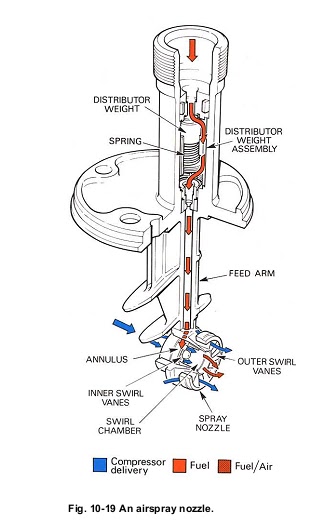
89. The final components of the fuel system are the fuel spray nozzles, which have as their essential function the task of atomizing or vaporizing the fuel to ensure its rapid burning. The difficulties involved in this process can be readily appreciated when one considers the velocity of the air stream from the compressor and the short length of combustion system (Part 4) in which the burning must be completed.

LOW PRESSURE FUEL SYSTEM

LOW PRESSURE FUEL SYSTEM


83. An L.P. system (fig.10-13) must be provided to supply the fuel to the engine at a suitable pressure, rate of flow and temperature, to ensure satisfactory engine operation. This system may include an L.P. pump to prevent vapour locking and cavitation of the fuel, and a fuel heater to prevent ice crystals forming. A fuel filter is always used in the system and in some instances the flow passes through an oil cooler (Part8). Transmitters may also be used to signal fuel pressure, flow and temperature (Part 12).

FUEL PUMPS


84. There are two basic types of fuel pump, the plunger-type pump and the constant-delivery gear-type pump; both of these are positive displacement pumps. Where low pressures are required at the fuel spray nozzles, the gear-type pump is preferred because of its lightness.

Monday, January 23, 2012

Fuel control system


Fuel system


hydro-mechanical, and the acceleration and speed control and pressure ratio control systems, which are mechanical. With the exception of the pressure ratio control system, which uses a gear-type pump, all the systems use a variable-stroke, multi-plunger type fuel pump to supply the fuel to the spray nozzles.

8. Some engines are fitted with an electronic system of control and this generally involves the use of electronic circuits to measure and translat changing engine conditions to automatically adjust the fuel pump output. On helicopters powered by gas turbine engines using the free-power turbine principle (Part 5), additional manual and automatic controls on the engine govern the free-power turbine and, consequently, aircraft rotor speed.