 |
| Fig. 7-3 An internal gearbox.
Direct drive
11. In some early engines, a radial driveshaft was used to drive each, or in some instances a pair, of
accessory units. Although this allowed each accessory unit to be located in any desirable location
around the engine and decreased the power transmitted through individual gears, it necessitated
a large internal gearbox. Additionally, numerous radial driveshafts had to be incorporated within the
design. This led to an excessive amount of time required for disassembly and assembly of the engine
for maintenance purposes.
|
Showing posts with label aero. Show all posts
Showing posts with label aero. Show all posts
Thursday, January 12, 2012
An internal gearbox,Direct drive

Sunday, November 20, 2011

Thursday, October 27, 2011
DESIGN AND DEVELOPMENT OF THE SWIFT: A FOOT-LAUNCHED SAILPLANE
Abstract
This paper describes the development of what might be considered the first successful ultralight sailplane.The SWIFT is a high performance foot-launched glider, designed to combine some of the convenience of hang gliders with the soaring performance of sailplanes. It takes off and lands like a hang glider, yet maintains exceptional performance at high speeds, achieving a lift-to-drag ratio of about 25:1. Although it is a fullycantilevered rigid wing with aerodynamic controls and flaps, it is light enough to launch by running from a hillside and is easily transported on the top of a car. This paper describes the design, development, and flying of this unique aircraft. Introduction and Background Introduction and Background
Pioneers of heavier-than-air flight were inspired with the idea of being able to fly like birds – not for the purpose of efficient, high-speed transportation, but for the shear freedom that such a capability would permit. This was the motivation for, and is the appeal of,modern soaring aircraft such as paragliders, hang gliders, and sailplanes. Although the performance of sailplanes has increased dramatically over many decades so that lift-to-drag ratios of 60:1 have been achieved and 1000 km flights are possible, certain aspects of high performance sailplanes seem counter to the vision espoused by Lilienthal and others [1]. Especially for a group of graduate students in the San Francisco Bay Area, the cost of sailplane flying, along with the long drive to an airport that supported such activities, meant that achieving the goal of bird-like flight was only somewhat more realizable than it was 100 years ago.Tuesday, October 25, 2011
principles Of Flight
Lesson Plan: Paper Glider Measurement
Grade Level: 5-6
Subject Area: Math
Time Required:
Subject Area: Math
Time Required:
- Preparation: 1 hour
- Activity: 2-3 hours
National Standards Correlation: Math (grade 3-5)
Measurement Standard:
Apply appropriate techniques, tools, and formulas to determine measurements.
- • Data Analysis and Probability Standard: Understand and apply basic concepts of probability.
- • Data Analysis and Probability Standard: Select and use appropriate statistic methods to analyze data.
- • Representation Standard: Use representation to model and interpret physical, social, and mathematical phenomena. Math (grades 6-8)
- • Measurement Standard: Apply appropriate techniques, tools, and formulas to determine measurements.
- • Data Analysis and Probability Standard: Understand and apply basic concepts of probability.
- • Data Analysis and Probability Standard: Select and use appropriate statistic methods to analyze data.
- • Representation Standard: Create and use representations to organize, record, and communicate mathematical ideas.
Saturday, September 3, 2011
X-Gliders: Exploring Flight Research with Experimental Gliders
Objectives
Standards and Skills

Science
Science as Inquiry
Physical Science
Science and Technology
Mathematics
Measurement
Problem Solving
Science Process Skills
Making Models
Investigating
Predicting
 Background Information
A look at the research aircraft flown by NASA and its predecessor, the National Advisory Committee for Aeronautics (NACA), since the 1940’s reveals an evolution of wing designs. In fact, each of the first series of NACA experimental research aircraft (“X-planes”) used different wing and tail configurations to tackle the problems of supersonic flight. These early jet aircraft had straight wings (X-1), wings that angled (swept) toward the tail (X-2), triangular (delta) wings (XF-92), and wings that could be moved in flight to change the angle of backward sweep (X-5). Each design added to our knowledge of high-speed flight.
 More recently, aircraft designs have incorporated wings that sweep forward (X-29), and even wings that sweep forward and backward at the same time (AD-1 oblique wing aircraft). The X-29 and X-31 also made use of small wing-like control surfaces called canards which are located ahead of the main wings. The X-36, which was flown during the late 1990’s, used canards and swept-back wings but had no vertical tail. (For additional background information see the Aircraft as Research Tools page at the end of this Educational Brief.)
- The students will:
- Build a glider.
- Learn how to change the flight characteristics of a glider.
- Conduct an experiment to answer a question.
Standards and Skills

Science
Science as Inquiry
Physical Science
Science and Technology
Mathematics
Measurement
Problem Solving
Science Process Skills
Making Models
Investigating
Predicting
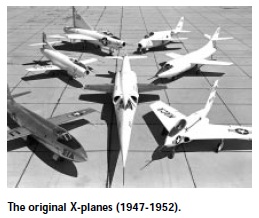
A look at the research aircraft flown by NASA and its predecessor, the National Advisory Committee for Aeronautics (NACA), since the 1940’s reveals an evolution of wing designs. In fact, each of the first series of NACA experimental research aircraft (“X-planes”) used different wing and tail configurations to tackle the problems of supersonic flight. These early jet aircraft had straight wings (X-1), wings that angled (swept) toward the tail (X-2), triangular (delta) wings (XF-92), and wings that could be moved in flight to change the angle of backward sweep (X-5). Each design added to our knowledge of high-speed flight.

Subscribe to:
Posts (Atom)